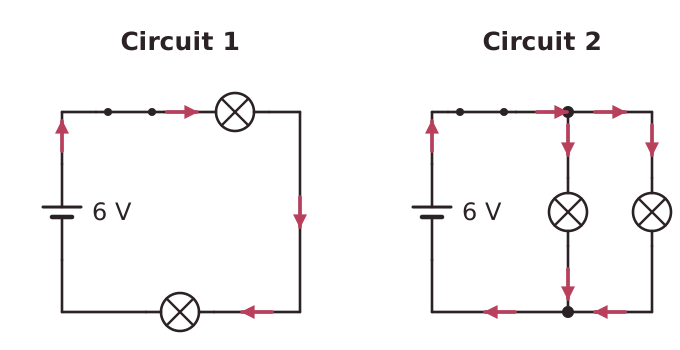
In a series circuit the components are connected one after another in a single loop, so the current has only one path. In a parallel circuit the components are on separate branches, each connected across the cell, so the current has more than one path to take.
In a series circuit the current is the same at every point. The potential difference (p.d.) of the cell is shared between the components, so the p.d. across each one is smaller than the p.d. of the supply. The energy transferred by the cell is shared between the components in the same way. For example, two identical lamps in series on a 6 V supply have 3 V across each lamp.
In a parallel circuit the p.d. across each branch is the same as the p.d. of the supply. The current from the cell splits at a junction between the branches and joins up again afterwards, so the currents in the branches add up to the total current. Each branch gets its energy from the cell separately. Adding another branch gives the current an extra path, so the total resistance falls.
An ammeter measures current and is connected in series, in the same loop as the component. A voltmeter measures p.d. and is connected in parallel, directly across the component it is measuring.