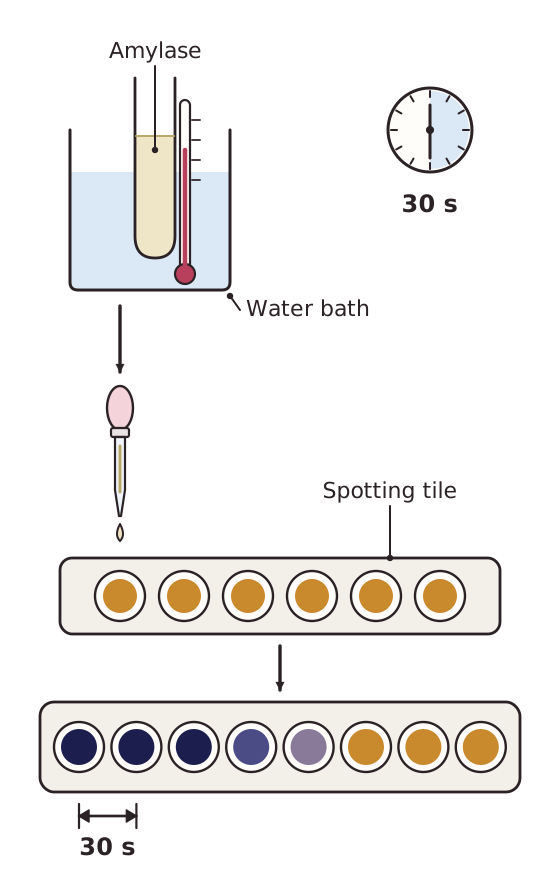
A common way to investigate an enzyme is to use amylase, which breaks down starch. Starch turns iodine solution blue-black. Once the starch has been broken down, the iodine stays orange-brown. Amylase and starch are mixed in a water bath, which keeps the temperature constant. Every 30 seconds a drop of the mixture is added to iodine on a spotting tile. The time taken for the iodine to stop turning blue-black is recorded.
Only one factor is changed each time. This is the independent variable, for example temperature or pH (a buffer solution holds the pH steady). The time for the starch to disappear is the dependent variable. Everything else is kept the same: the volume and concentration of amylase and starch, and the pH or temperature that is not being tested. The experiment is repeated so that a mean can be calculated, which makes the results more reliable.
A shorter time means a faster rate. The rate can be calculated as 1 divided by the time, so a reaction that takes 20 seconds has a rate of 1 ÷ 20 = 0.05 per second. The rates are then plotted on a graph, with the independent variable on the x-axis. Another method uses catalase with hydrogen peroxide and measures the volume of oxygen gas collected in a set time.