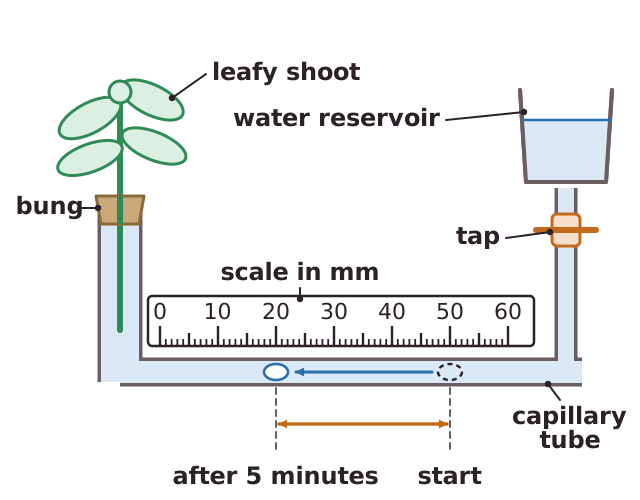
The rate of transpiration is the volume of water lost, or taken up, in a certain time. Rate = amount of water ÷ time. A potometer measures how much water a plant takes up, which is close to the water it loses. A bubble in a thin capillary tube moves along as the plant takes up water. The distance the bubble moves in a set time shows the rate of water uptake.
Worked examples. A bubble moves 30 mm in 5 minutes, so the rate is 30 ÷ 5 = 6 mm per minute. A plant takes up 1.2 cm3 of water in 4 minutes, so the rate is 1.2 ÷ 4 = 0.3 cm3 per minute. At that rate it would take up 3 cm3 in 10 minutes.
Another method is to weigh a potted plant. If it loses 12 g in 3 hours, mainly as water vapour, the rate is 12 ÷ 3 = 4 g per hour.
To compare conditions fairly, change only the independent variable, such as light intensity, and keep the others the same. Repeat the readings and find the mean to improve reliability.