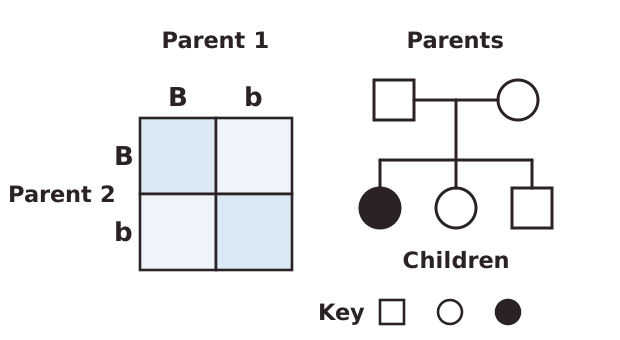
In a monohybrid cross we follow the inheritance of one gene that has two alleles. The dominant allele is written as a capital letter, such as B, and the recessive allele as a lower case letter, b. A person or organism with two identical alleles (BB or bb) is homozygous. One with two different alleles (Bb) is heterozygous, and shows the dominant phenotype.
Each parent makes gametes that carry only one allele of the gene. A heterozygous parent (Bb) makes two kinds of gamete, B and b, in equal numbers. A Punnett square lays out the gametes of one parent along the top and the other parent down the side, and each box shows a possible offspring genotype. For Bb × Bb the boxes show BB, Bb, Bb and bb. Three of the four offspring show the dominant phenotype and one shows the recessive phenotype, a ratio of 3 : 1.
A family pedigree shows how a characteristic passes through generations. Squares stand for males and circles for females, and shaded shapes show people with the characteristic. If two unaffected parents have an affected child, the characteristic must be recessive, and both parents must be heterozygous carriers.