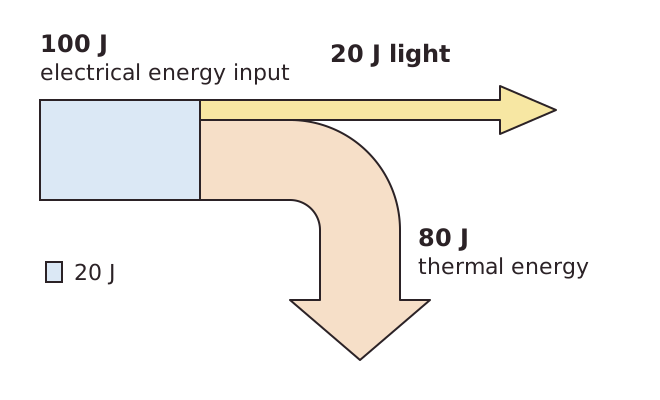
No device transfers all of its input energy usefully. The efficiency of an energy transfer tells you what fraction of the input energy is transferred usefully. It is calculated with:
efficiency = useful output energy transfer ÷ total input energy transfer
Efficiency can also be found from power: efficiency = useful power output ÷ total power input. Both forms give the same answer because power is energy transferred per second.
Efficiency can be given as a decimal or as a percentage. To change a decimal into a percentage, multiply by 100. For example, a lamp takes in 100 J of electrical energy and transfers 20 J as light. Its efficiency is 20 ÷ 100 = 0.2, which is 20%. The other 80 J is dissipated as thermal energy. Efficiency can never be more than 1 (100%), because that would mean energy had been created, and energy cannot be created.
Worked examples. A 60 W lamp with an efficiency of 0.25 gives 15 W of useful power, so 45 W is wasted. A machine with an input of 200 J that wastes 50 J has a useful output of 150 J, so its efficiency is 0.75, or 75%.
To increase the efficiency of an intended energy transfer, you reduce the energy that is wasted. For example, you can lubricate moving parts to reduce friction, or use insulation to reduce heat loss.