When a substance is heated, energy is stored in its thermal store and its temperature rises. The change in thermal energy is found with ΔE = m × c × Δθ. Here ΔE is the change in thermal energy in joules (J), m is the mass in kilograms (kg), c is the specific heat capacity in J/kg °C and Δθ is the temperature change in degrees Celsius (°C).
The specific heat capacity of a substance is the energy needed to raise the temperature of one kilogram of the substance by one degree Celsius. A substance with a high specific heat capacity needs more energy for each degree of warming, so it heats up more slowly. For example, 2 kg of water (c = 4200 J/kg °C) warmed by 10 °C stores an extra 2 × 4200 × 10 = 84000 J.
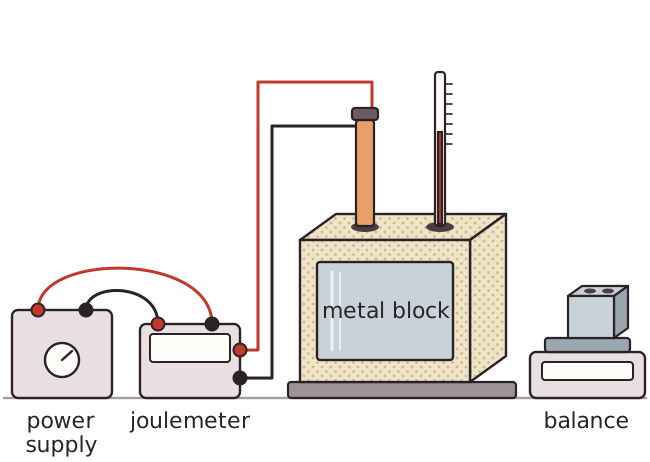
In the required practical, you find c for a material such as a metal block. An electric heater is placed in the block, which is wrapped in insulation to reduce energy lost to the surroundings. A thermometer measures the temperature rise while the heater transfers a known amount of energy, found from the power and the time or from a joulemeter. The energy supplied is linked to the increase in thermal energy stored. Rearranging the equation gives c = ΔE ÷ (m × Δθ).
Some energy always escapes to the surroundings. The energy supplied is then more than the energy stored in the block, so the calculated value of c comes out too high. Better insulation gives a result closer to the true value.