Almost all life on Earth depends on photosynthetic organisms. These are the producers of biomass. They use light to make glucose by photosynthesis, which they turn into the molecules that build their bodies. The producer is usually a green plant or an alga, and every food chain starts with one.
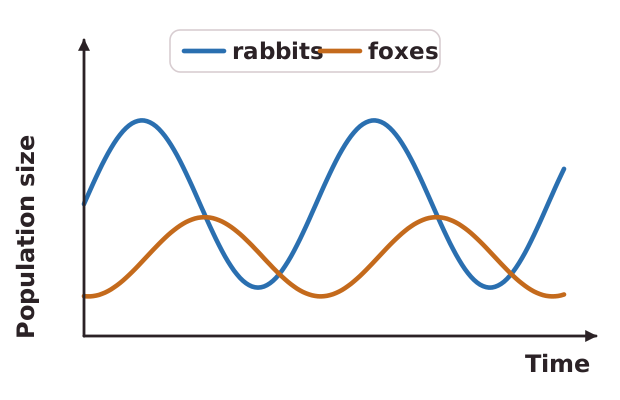
A food chain shows who eats whom. A producer is eaten by a primary consumer, which may be eaten by a secondary consumer, and that may be eaten by a tertiary consumer. An animal that kills and eats other animals is a predator, and the animal it eats is its prey. In a stable community the numbers of predators and prey rise and fall in cycles. If prey numbers go up, predators get more food and their numbers rise a little later. The extra predators eat more prey, so prey numbers drop, and then the predators go short of food and fall in number too. On a graph, the predator peak comes after the prey peak.
Ecologists use quadrats and transects to find out how many organisms live in a habitat. A quadrat is a square frame that you place on the ground so you can count the organisms inside it. A transect is a straight line laid across a habitat, and you place quadrats along it to see how the distribution of a species changes with a factor such as light or distance from a tree. For required practical 7, you place quadrats at random to estimate the population size of a common species, and you use a transect to investigate how a factor affects where that species is found.
To describe abundance you can use three averages. The mean is the total divided by the number of values. The median is the middle value when the results are in order. The mode is the value that occurs most often.