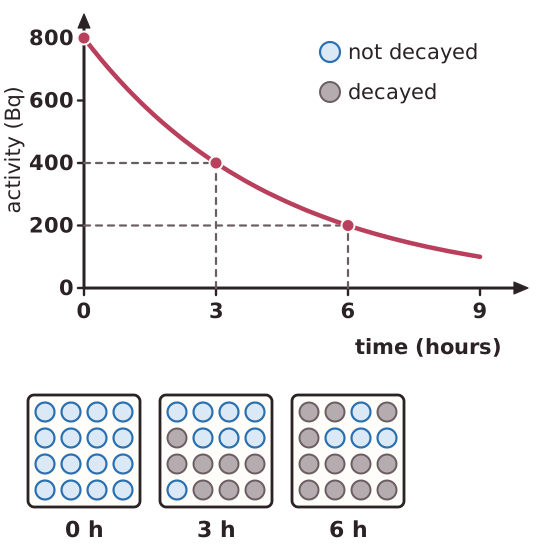
Radioactive decay is random. We cannot predict when one particular nucleus will decay, and it is not affected by how long the nucleus has existed. When a sample contains a very large number of nuclei, though, the decay of the whole sample follows a pattern we can predict.
The half-life of an isotope is the time it takes for the number of nuclei of the isotope in a sample to halve. It is also the time it takes for the count rate, or the activity, from a sample to fall to half its initial level. A source with an activity of 800 Bq and a half-life of 3 hours falls to 400 Bq after 3 hours, then to 200 Bq after 6 hours. After one half-life the activity is a half of the start, and after two half-lives it is a quarter.
To find a half-life from data, find how long the count rate takes to halve. If a count rate falls from 80 to 40 counts per second in 5 days, the half-life is 5 days. (Higher tier only: after a number of half-lives the decline can be given as a ratio. After three half-lives, one eighth of the activity is left, so the net decline is 1 to 8.)