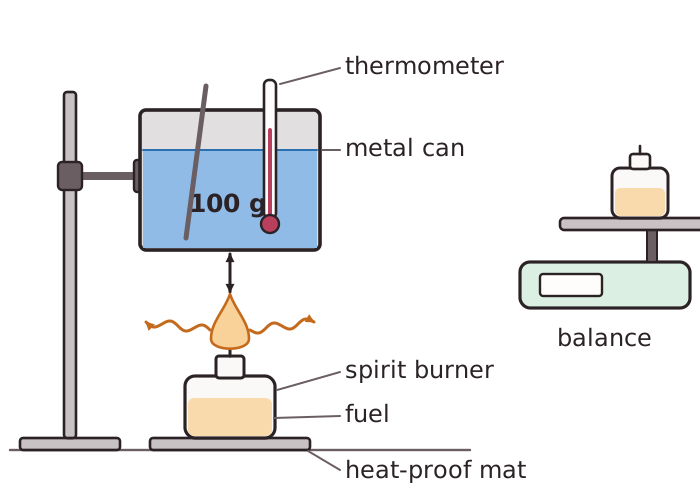
In this practical you compare how much energy the alcohols ethanol, propanol, butanol and pentanol release when they burn. Each fuel is burned in a spirit burner under a metal can containing a known mass of water, for example 100 g. You measure the starting temperature of the water, burn the fuel for a set time with the water stirred, then measure the final temperature.
Weigh the burner before and after, so the difference gives the mass of fuel burned. Divide the energy gained by the water by the mass of fuel burned to compare the fuels. The energy gained by the water is found from Q = m × c × ΔT, where c is the specific heat capacity of water, 4.2 J/g°C. For 100 g of water rising by 25°C: 100 × 4.2 × 25 = 10500 J.
To make it a fair test, keep the mass of water, the starting temperature and the distance between the flame and the can the same each time. The results show that the alcohols with more carbon atoms release more energy per mole, and they also release more energy per gram. Pentanol therefore releases more energy per gram of fuel burned than butanol, propanol or ethanol.
The measured energy is always lower than the true value, because heat is lost to the surroundings and the alcohol may burn incompletely, giving soot.