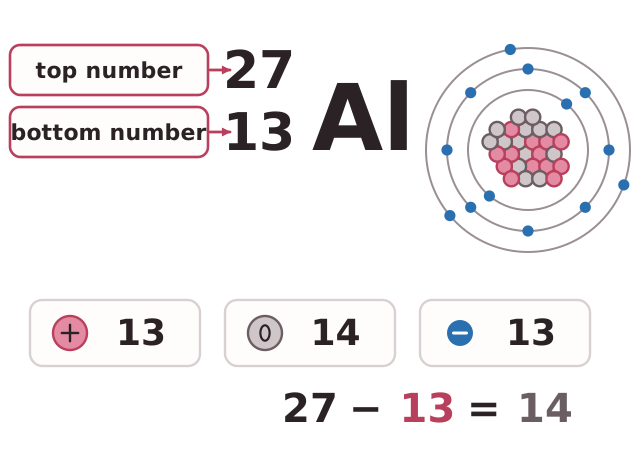
An atom has a tiny nucleus made of protons and neutrons, with electrons in shells around it. Protons and neutrons are the two particles that make up almost all of an atom's mass. Electrons have so little mass that they are ignored when we count mass.
The mass number of an atom is the total number of protons and neutrons in its nucleus. It is always a whole number. For example, a carbon atom with 6 protons and 6 neutrons has a mass number of 12. The mass number is written as the larger number in the nuclear symbol, for example 126C, with the smaller number below it being the atomic number.
Because the mass number counts protons and neutrons but not electrons, a sodium atom with 11 protons and 12 neutrons has a mass number of 23. If you know the mass number and the number of protons, you can find the number of neutrons by subtraction. For example, an atom with mass number 19 and 9 protons has 19 − 9 = 10 neutrons.