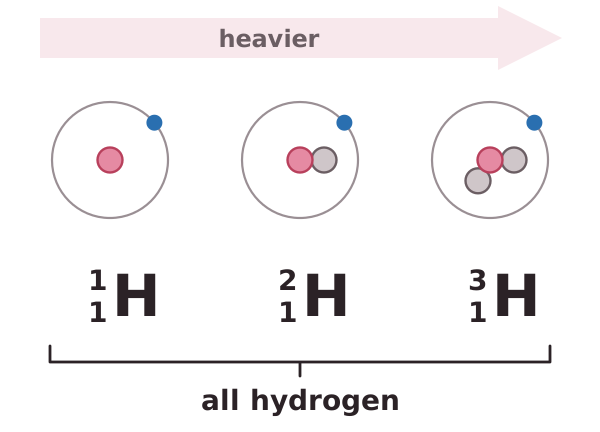
Atoms of the same element always have the same number of protons, but they can have different numbers of neutrons. Isotopes are different atoms of the same element that have the same number of protons but different numbers of neutrons in their nuclei.
Because the number of neutrons is different, isotopes of an element have different mass numbers. Chlorine has two common isotopes. Both have 17 protons, but one has 18 neutrons (mass number 35) and the other has 20 neutrons (mass number 37). They are written 3517Cl and 3717Cl.
Isotopes of an element have the same number of electrons as protons, so they have the same electron arrangement and react in the same chemical way. They differ only in their mass. Carbon-12 and carbon-14 are other examples: both have 6 protons, but carbon-12 has 6 neutrons and carbon-14 has 8 neutrons.