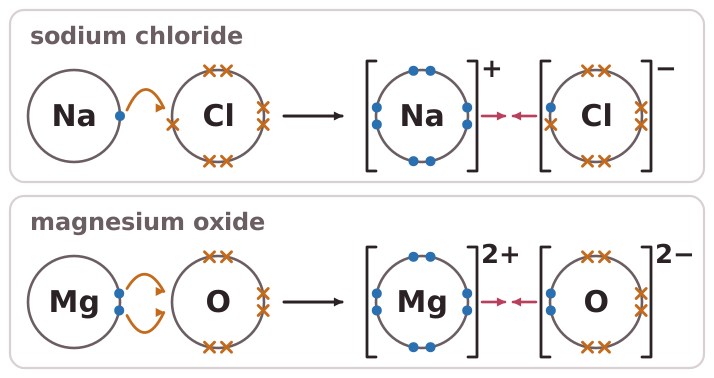
Atoms form ions so that they have a full outer shell of electrons. The group number tells you which ion an atom forms. Group 1 atoms lose one electron to form 1+ ions, such as Na+. Group 2 atoms lose two electrons to form 2+ ions, such as Mg2+ and Ca2+. Metals in Groups 1 and 2 therefore form ions with a positive charge.
Each Group 6 atom gains two electrons to form a 2- ion, such as the oxide ion O2- (2.6 becomes 2.8). Group 7 atoms gain one electron to form 1- ions, such as the chloride ion Cl- (2.8.7 becomes 2.8.8). Non-metals in Groups 6 and 7 form ions with a negative charge. Magnesium, 2.8.2, loses two electrons to become Mg2+ with the configuration 2.8.
An ionic compound is electrically neutral, so the total positive charge must equal the total negative charge. Calcium oxide, CaO, has one Ca2+ for each O2-. Magnesium chloride needs two Cl- ions for every Mg2+ ion, so its formula is MgCl2. Sodium oxide needs two Na+ ions for each O2- ion, so its formula is Na2O.