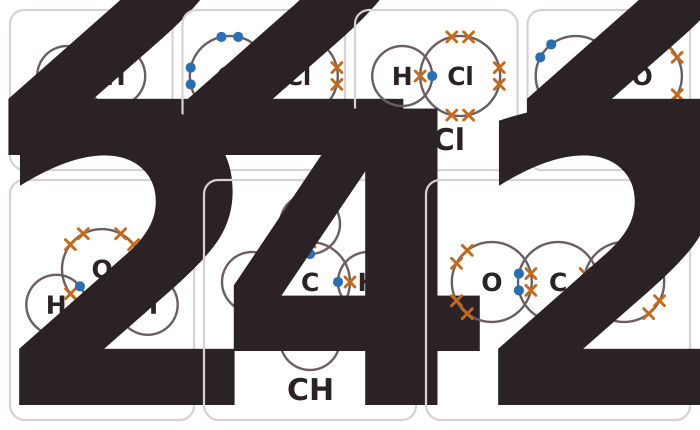
A covalent bond forms when two atoms share a pair of electrons. Covalent bonds usually form between non-metal atoms. Each atom provides one electron to the shared pair, and the pair belongs to both atoms at the same time.
The shared pair of electrons is attracted to the positive nuclei of both atoms. This strong electrostatic attraction holds the two atoms together. Sharing also gives each atom a full outer shell of electrons, which makes the arrangement stable.
In hydrogen, each atom has one electron. Two hydrogen atoms share a pair, so each atom has two electrons in its outer shell, which is a full shell for hydrogen. A chlorine atom has seven electrons in its outer shell. Two chlorine atoms share one pair, so each atom has eight electrons in its outer shell.