If a reaction can take place by two routes the total enthalpy change for each route is the same provided that the starting and finishing conditions are the same.Hess's Law is a consequence of the law of Conservation of Energy.In the following reactions, ΔHr = ΔHc(carbon) + ΔHc (hydrogen) - ΔHc(ethanol), taking the combustion enthalpies of carbon and hydrogen for 2 mol of C and 3 mol of H2
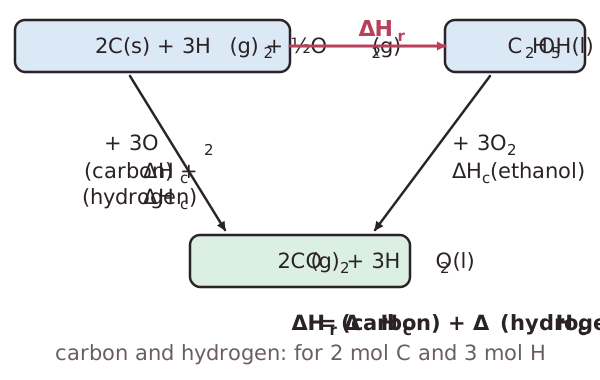
Hess's Law
Read the text
Read the text and highlight anything you think is important. When you go on, the text is hidden and you answer from memory.
Specification: OCR Chemistry A (H032), AS-level, 3.2.1 Enthalpy changes. Topic: Enthalpy.
Key terms in this lesson
- Enthalpy
- A measure of the total energy of a chemical system.
- Enthalpy change
- The heat energy that is transferred between the system and its surroundings during a process carried out at constant pressure.
More in Enthalpy
- Determining the Enthalpy Change of a Reaction
- Cooling Curves
- Average Bond Enthalpy
- Calculating Enthalpy Changes from Bond Enthalpies
- Limitations of Bond Enthalpy Calculations
- Determination of Enthalpy Change of a Reaction from Enthalpies of Formation Using Hess's Law
- Determination of Enthalpy Change of a Reaction from Enthalpies of Combustion using Hess's Law
- Exam-style Question
All 19 lessons in Enthalpy · All OCR AS-level Chemistry topics