When a reversible reaction takes place in a closed system (nothing can enter or leave), it eventually reaches dynamic equilibrium.At the start, only reactants are present, so the forward reaction is fast and there is no backward reaction. As reactants are used up, the forward rate falls. As products build up, the backward rate rises. Eventually the two rates become equal.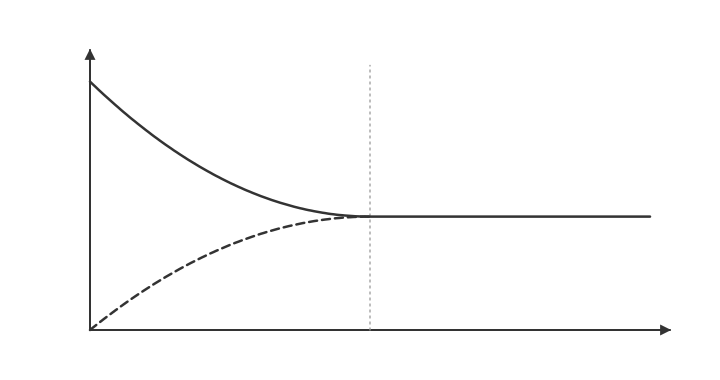
• the concentrations of reactants and products stay constant
• both reactions are still happening, which is why it is called dynamic.Constant does not mean equal. At equilibrium there may be far more products than reactants, or far more reactants than products. The position of equilibrium describes this: if the mixture is mostly products, the equilibrium lies to the right.Because the concentrations are constant, observable (macroscopic) properties such as colour, pressure and density do not change, even though particles are still reacting.The same equilibrium mixture is reached whether you start from the reactants or from the products, as long as the conditions and total amounts of each element are the same.Evidence that equilibrium is dynamic comes from isotopic labelling. If a little deuterium, D2, is added to a mixture of H2, I2 and HI at equilibrium, DI soon appears, even though the overall concentrations do not change.