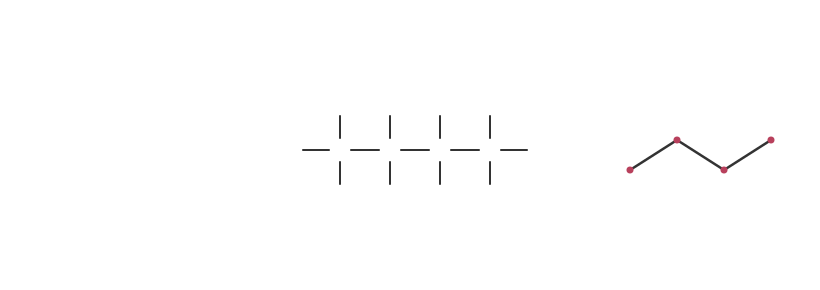
Organic molecules can be shown with several types of formula. Using butane as the example:Molecular formula: the actual number of atoms of each element in one molecule, C4H10.Empirical formula: the simplest whole-number ratio of atoms of each element, C2H5.General formula: an algebraic formula for a whole family of compounds, CnH2n+2 for the alkanes.Structural formula: the minimal detail needed to show the arrangement of atoms, carbon by carbon, CH3CH2CH2CH3. Branches go in brackets, so 2-methylpropane is CH3CH(CH3)CH3.Displayed formula: shows every atom and every bond as a line.Skeletal formula: the carbon chain is drawn as a zigzag of lines. Carbon atoms, and hydrogen atoms bonded to carbon, are not written. Each end of a line and each junction is a carbon atom, and functional groups such as OH or Cl are drawn in full.