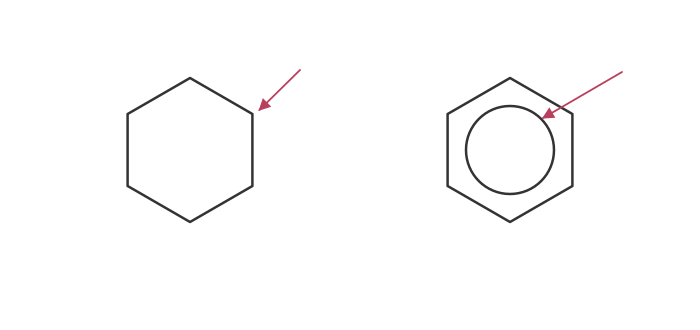
In many organic compounds the carbon atoms form open chains, which may be straight or branched. These are aliphatic compounds. In cyclic compounds, some of the carbon atoms are joined in a ring.There are two kinds of cyclic hydrocarbon.Alicyclic compounds have a ring that is not aromatic. The cycloalkanes are the simplest examples: cyclopropane, C3H6, cyclobutane, C4H8, cyclopentane, C5H10, and cyclohexane, C6H12. They are named by adding the prefix cyclo to the name of the alkane with the same number of carbon atoms.Aromatic compounds (arenes) contain a benzene ring, C6H6, in which six electrons are delocalised around the ring.Closing a chain into a ring removes two hydrogen atoms, one from each end, to make the extra C-C bond. So cycloalkanes with one ring have the general formula CnH2n, the same as the alkenes. Cyclohexane and hex-1-ene are both C6H12, but cyclohexane is saturated: it has only single bonds and does not decolourise bromine water.Cyclic compounds are usually drawn as skeletal formulae. Cyclohexane is a hexagon, where each corner is a carbon atom carrying two hydrogen atoms. Benzene is a hexagon with a circle inside, showing the delocalised electrons.