Structural isomers are compounds with the same molecular formula but a different structural formula. Their atoms are bonded together in a different order. There are three types.1. Chain isomers have different arrangements of the carbon chain, for example straight and branched chains.
C4H10: butane, CH3CH2CH2CH3, and 2-methylpropane, CH3CH(CH3)CH3.
C5H12 has three chain isomers: pentane, 2-methylbutane and 2,2-dimethylpropane.2. Position isomers have the same carbon chain and the same functional group, but the functional group is on a different carbon.
C3H7Cl: 1-chloropropane, CH3CH2CH2Cl, and 2-chloropropane, CH3CHClCH3.
C4H8: but-1-ene and but-2-ene.3. Functional group isomers have different functional groups, so they belong to different homologous series.
C2H6O: ethanol, CH3CH2OH (an alcohol), and methoxymethane, CH3OCH3 (an ether).
C3H6: propene (an alkene) and cyclopropane (a cycloalkane).Chain isomers have similar chemical properties but different physical properties: branched isomers have fewer points of contact, weaker London forces and lower boiling points. Functional group isomers have different chemical properties too.Tip: when drawing isomers, check you have not simply drawn the same molecule bent or turned round. CH3CH2CH2CH3 drawn with a bend is still butane; name each structure to check.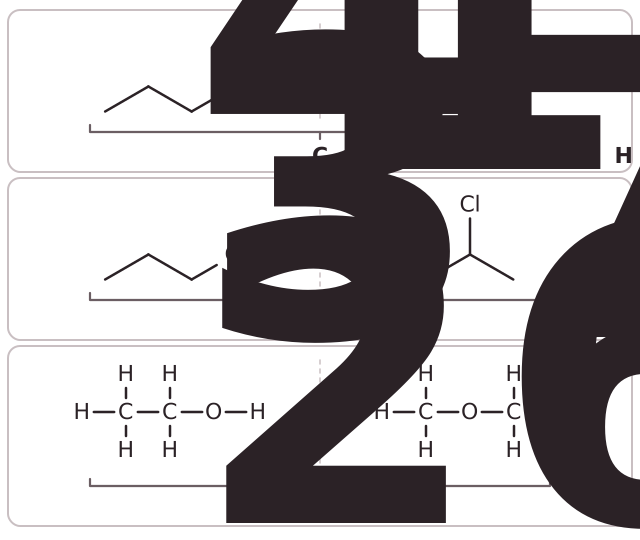
C4H10: butane, CH3CH2CH2CH3, and 2-methylpropane, CH3CH(CH3)CH3.
C5H12 has three chain isomers: pentane, 2-methylbutane and 2,2-dimethylpropane.2. Position isomers have the same carbon chain and the same functional group, but the functional group is on a different carbon.
C3H7Cl: 1-chloropropane, CH3CH2CH2Cl, and 2-chloropropane, CH3CHClCH3.
C4H8: but-1-ene and but-2-ene.3. Functional group isomers have different functional groups, so they belong to different homologous series.
C2H6O: ethanol, CH3CH2OH (an alcohol), and methoxymethane, CH3OCH3 (an ether).
C3H6: propene (an alkene) and cyclopropane (a cycloalkane).Chain isomers have similar chemical properties but different physical properties: branched isomers have fewer points of contact, weaker London forces and lower boiling points. Functional group isomers have different chemical properties too.Tip: when drawing isomers, check you have not simply drawn the same molecule bent or turned round. CH3CH2CH2CH3 drawn with a bend is still butane; name each structure to check.