The cis-trans names only work when the same group is on both carbons of the C=C. The E-Z system names every geometric isomer, using the Cahn-Ingold-Prelog (CIP) priority rules.Step 1: look at one carbon of the double bond. Of its two groups, the one whose directly attached atom has the higher atomic number has the higher priority.
Step 2: do the same for the other carbon.
Step 3: if the two higher-priority groups are on the same side, the isomer is Z (German zusammen, together). If they are on opposite sides, it is E (entgegen, opposite).Useful atomic numbers: H = 1, C = 6, O = 8, Cl = 17, Br = 35, I = 53. If the first atoms are the same, compare the atoms attached to them until there is a difference.Worked example: 1-bromo-1-chloropropene, CBrCl=CHCH3.
Carbon 1: Br (35) beats Cl (17), so Br has priority.
Carbon 2: CH3 (C, 6) beats H (1), so CH3 has priority.
Br and CH3 on the same side: (Z)-1-bromo-1-chloropropene. On opposite sides: (E)-1-bromo-1-chloropropene.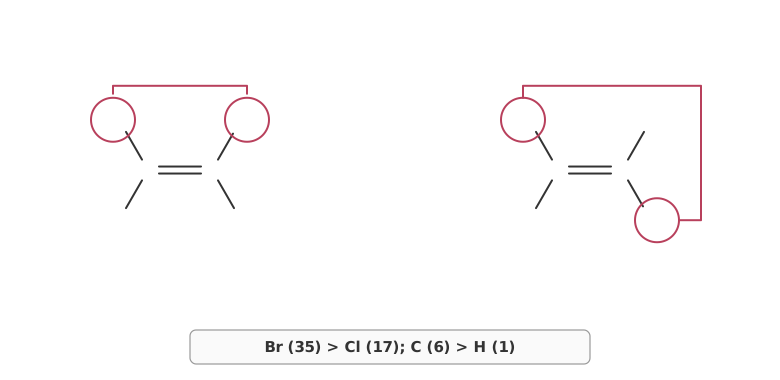
Step 2: do the same for the other carbon.
Step 3: if the two higher-priority groups are on the same side, the isomer is Z (German zusammen, together). If they are on opposite sides, it is E (entgegen, opposite).Useful atomic numbers: H = 1, C = 6, O = 8, Cl = 17, Br = 35, I = 53. If the first atoms are the same, compare the atoms attached to them until there is a difference.Worked example: 1-bromo-1-chloropropene, CBrCl=CHCH3.
Carbon 1: Br (35) beats Cl (17), so Br has priority.
Carbon 2: CH3 (C, 6) beats H (1), so CH3 has priority.
Br and CH3 on the same side: (Z)-1-bromo-1-chloropropene. On opposite sides: (E)-1-bromo-1-chloropropene.