How to do a Flame Test
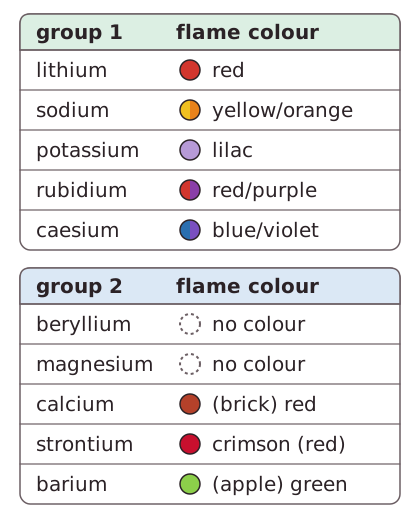
•Wear safety glasses and a labcoat and carry out in a fume cupboard.•Dip a clean nichrome metal wire into concentrated hydrochloric acid•Dip the wire into the solid sample (the acid converts it to a more volatile chloride)• Hold the wire at the top of a blue bunsen flame and observe the colourProblems:• intense colour of sodium impurities can mask other colours•describing colours is subjectiveIn group one, rubidium and caesium give red-violet and blue-violet flame colours respectively.From group two, barium gives a pale-green flame colour and calcium gives a brick-red flame colour.
What Causes Colours in Flame Tests
Electrons absorb heat energy from the flame and transition to a higher energy level or excited state. The electrons immediately fall back to their ground state emitting a photon of visible light of a frequency characteristic of the atom.The electron transition energies are related to the frequencies emitted by the equation E = hf where h is the Planck constant.The electron transition in sodium corresponds to a wavelength of 590nm (yellow).The electron transition in magnesium corresponds to a wavelength outside the visible spectrum (no flame colour).Flame Test Colours