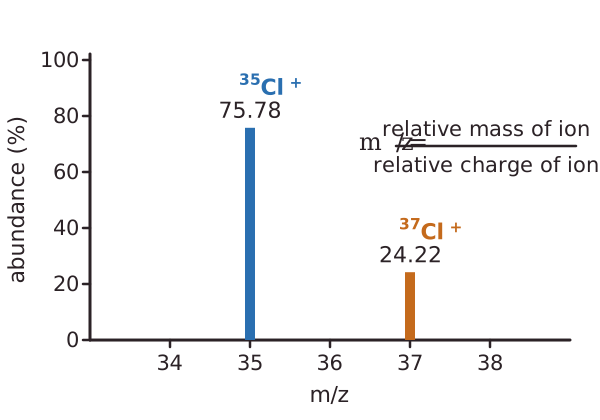
A mass spectrometer measures the mass of atoms and molecules
The mass spectrometer can be used to experimentally measure the percentage abundances of
isotopes in a sample of an element or deduce the structure of a molecule by analysing positively charged molecules and their positively charged fragments.
- The sample is placed in the mass spectrometer and vaporised
- The vaporised sample is ionised to form positive ions.
- The ions are accelerated by an electric field.
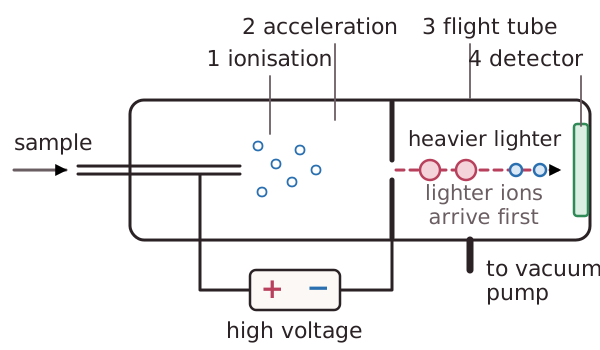
- The time of flight depends on the mass of the isotope, molecules or fragment.
- A detector detects the ions as a pulse or current. The greater the abundance the larger the current which produces a larger signal.
- The mass-to-charge or m/z ratio of all the signals is output as a mass spectrum.