Isotopes are atoms of the same element with the same number of protons and different number of neutrons
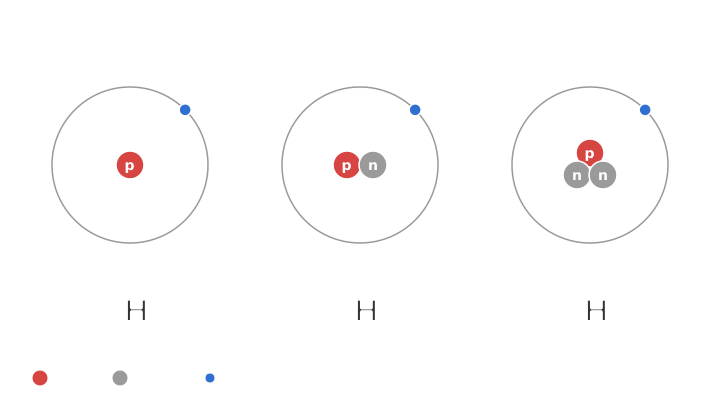
Hydrogen has three isotopes: hydrogen-1 (1 proton, 0 neutrons), hydrogen-2 or deuterium (1 proton, 1 neutron) and hydrogen-3 or tritium (1 proton, 2 neutrons). They all have the same atomic number but different mass numbers.Isotopes are written with the mass number at the top left and the atomic number at the bottom left of the symbol, for example 3517Cl and 3717Cl. Chlorine-35 has 17 protons and 18 neutrons; chlorine-37 has 17 protons and 20 neutrons. Both have 17 electrons.Chemical properties: isotopes of an element have the same number of electrons and the same electronic configuration. Chemical reactions involve electrons, so isotopes react in the same way.Physical properties: isotopes have different masses, so properties that depend on mass, such as density and rate of diffusion, are slightly different.Worked example: how many neutrons are in an atom of 136C?neutrons = mass number – atomic number = 13 – 6 = 7
Read the text
Read the text and highlight anything you think is important. When you go on, the text is hidden and you answer from memory.
Specification: Edexcel Chemistry (8CH0), AS-level, Topic 1: Atomic Structure and the Periodic Table. Topic: Atomic Structure.
Key terms in this lesson
- atomic number
- The number of protons in the nucleus of an atom, unique to each element.
- mass number
- The total number of protons and neutrons in the nucleus of an atom.
More in Atomic Structure
- Discovery of Atomic Structure
- Structure of the Atom
- Atomic Number and Mass Number
- Relative Isotopic Mass
- Relative Atomic Mass
- Mass Spectrometer
- Relative Atomic Mass from a Mass Spectrometer
- Relative Molecular Mass from a Mass Spectrometer
All 19 lessons in Atomic Structure · All Edexcel AS-level Chemistry topics