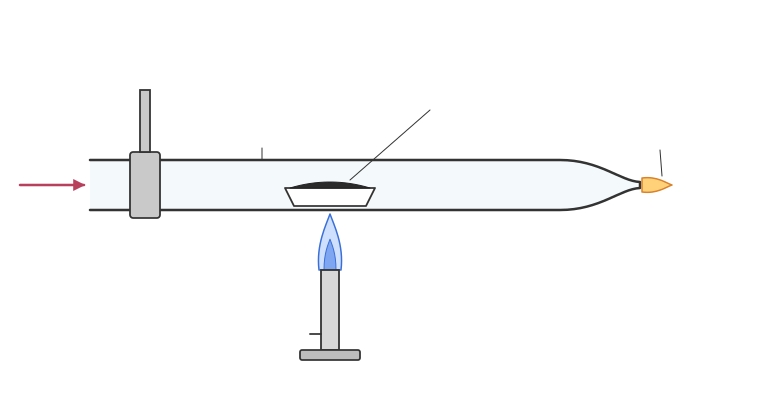
If there are two possible reactions for the same reactants, the reacting masses can be used to identify which reaction has taken place.For example, copper forms two oxides CuO and Cu2O, copper(II) oxide and copper(I) oxide.An oxide of copper is heated in a stream of hydrogen to constant mass.This forms copper and water. By working out the ratio of moles of copper to the ratio of moles of oxygen from their masses, the formula of the copper oxide can be found.
Working out Equations from Reacting Masses
Read the text
Read the text and highlight anything you think is important. When you go on, the text is hidden and you answer from memory.
Specification: Edexcel Chemistry (8CH0), AS-level, Topic 5: Formulae, Equations and Amounts of Substance. Topic: Amount of Substance and Calculations.
Key terms in this lesson
- mole
- The amount of substance containing 6.02 x 10^23 particles, the same number as the atoms in 12 g of carbon-12.
More in Amount of Substance and Calculations
- Ionic Equations - Question 2
- Ionic Equations - Question3
- Ionic Equations - Question 4
- Calculations of Reacting Masses
- Empirical Formula
- Percentage Composition by Mass
- Combustion Analysis
- Molecular Formula
All 39 lessons in Amount of Substance and Calculations · All Edexcel AS-level Chemistry topics