Reforming converts straight-chain alkanes into branched-chain alkanes and cyclic hydrocarbons (cycloalkanes and arenes such as benzene). The chain is rearranged, not broken into smaller pieces as in cracking.The reason is combustion. Straight-chain alkanes in petrol tend to ignite too early in an engine, before the spark, giving uneven burning called knocking. Branched and cyclic hydrocarbons burn more smoothly and efficiently, so they are blended into petrol to improve its quality.Reforming is carried out by heating the alkanes with a platinum catalyst (often on an aluminium oxide support). Hydrogen is a useful by-product.Types of reaction:Isomerisation (straight to branched chain, same formula):
CH3CH2CH2CH2CH3 → CH3CH(CH3)CH2CH3
pentane → 2-methylbutaneCyclisation (chain to ring, losing hydrogen):
C6H14 → C6H12 + H2
hexane → cyclohexane + hydrogenAromatisation (ring to arene):
C6H12 → C6H6 + 3H2
cyclohexane → benzene + hydrogen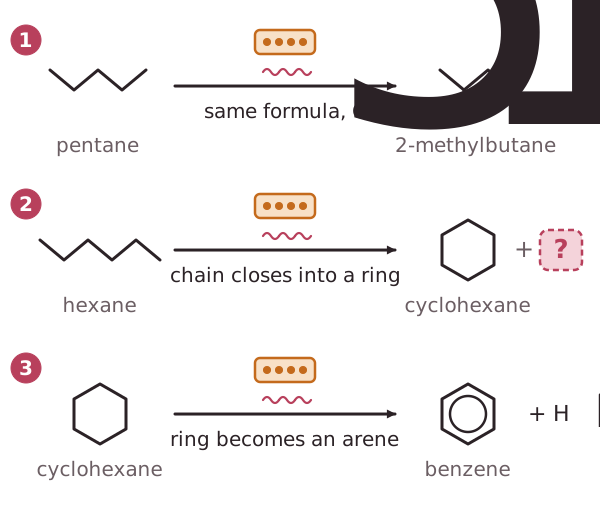 Worked example: heptane, C7H16, is reformed into methylcyclohexane, C7H14. The carbon atoms balance (7 = 7) and 16 - 14 = 2 hydrogen atoms are lost, so the other product is H2:
C7H16 → C7H14 + H2
pentane → 2-methylbutaneCyclisation (chain to ring, losing hydrogen):
hexane → cyclohexane + hydrogenAromatisation (ring to arene):
cyclohexane → benzene + hydrogen
Worked example: heptane, C7H16, is reformed into methylcyclohexane, C7H14. The carbon atoms balance (7 = 7) and 16 - 14 = 2 hydrogen atoms are lost, so the other product is H2: