The chemistry of each element is determined by its electron configuration, in particular, the number of electrons in the outermost (highest energy) shell. As you go down a group, there is an extra shell, but the same number of electrons in the outermost shell.The periodic table can be divided into blocks. The s-block, p-block, d-block and f-block correspond to the sub-shell (s, p, d or f) that holds the highest energy electrons of the elements within the block.
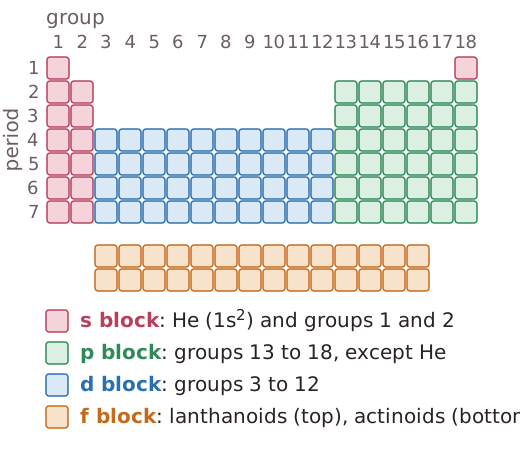
The old numbering system numbers groups 1 - 7, which matches the number of electrons in the highest energy shell, and then 0 for the noble gases.The new system numbers the groups from 1 to 18.
s, p, d and f Block
Read the text
Read the text and highlight anything you think is important. When you go on, the text is hidden and you answer from memory.
Specification: AQA Chemistry (7404), AS-level, 3.2.1.1 Classification. Topic: Periodicity.
Key terms in this lesson
- Electron configuration
- The arrangement of electrons in an atom's shells and sub-shells, written using numbers and letters such as 1s2 2s2.
- Group
- A vertical column of the periodic table, containing elements with the same number of outer-shell electrons.
More in Periodicity
- The Periodic Table
- Metals and Non-Metals
- Groups
- Periods
- Reactivity
- Hydrogen and Helium
- Periodicity and Period 3 Elements
- Trends in Melting and Boiling Points
All 14 lessons in Periodicity · All AQA AS-level Chemistry topics