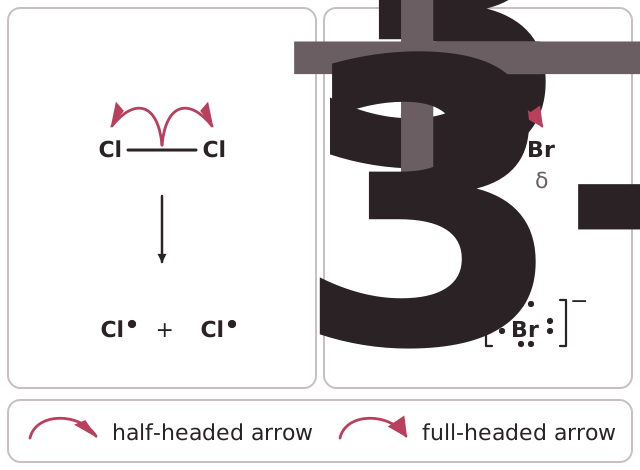
When a covalent bond breaks, the two electrons in the shared pair can be shared out in two ways. This is called bond fission.In homolytic fission, each atom takes one electron from the bond. This forms two free radicals. A free radical is a species with an unpaired electron, shown by a dot, for example Cl2 → 2Cl•. Homolytic fission usually needs energy from UV light or a high temperature.In heterolytic fission, one atom takes both electrons from the bond. This forms a positive ion and a negative ion, for example CH3Br → CH3+ + Br-. The more electronegative atom usually takes the pair.Curly arrows are used in mechanisms to show the movement of a pair of electrons. The arrow starts at a bond or a lone pair and points to where the electrons end up.