To interpret an IR spectrum, match the main absorptions above 1500 cm−1 to bonds using the data sheet, then decide which functional group fits.Step by step
1. Look for C=O: a strong, sharp absorption at 1680 to 1750 cm−1.
2. Look for O-H: a broad absorption at 3230 to 3550 cm−1 is an alcohol O-H. A very broad absorption at 2500 to 3000 cm−1 is a carboxylic acid O-H.
3. Check for other bonds such as N-H (3300 to 3500), C=C (1620 to 1680) or C≡N (2220 to 2260).
4. Do not rely on C-H (2850 to 3300), which almost every organic molecule shows.Then combine the evidence:
O-H (alcohol) and no C=O: alcohol
C=O and no O-H: aldehyde or ketone
C=O and very broad O-H (acid): carboxylic acid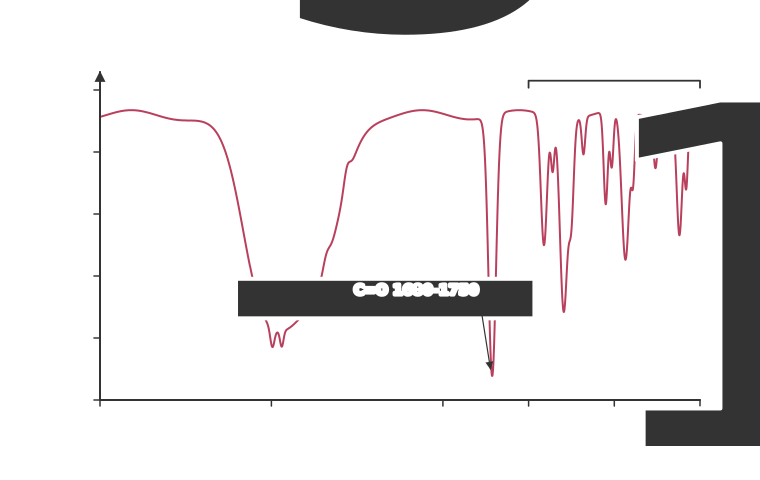
1710 cm−1: C=O.
Very broad 2500 to 3000 cm−1: O-H of a carboxylic acid.
So it is ethanoic acid, CH3COOH.IR can also follow a reaction. When ethanol is oxidised to ethanal, a C=O absorption appears and the alcohol O-H absorption disappears. If the product were ethanoic acid, there would be a C=O absorption and a very broad acid O-H absorption.In answers, always quote both the bond and its wavenumber range.
1. Look for C=O: a strong, sharp absorption at 1680 to 1750 cm−1.
2. Look for O-H: a broad absorption at 3230 to 3550 cm−1 is an alcohol O-H. A very broad absorption at 2500 to 3000 cm−1 is a carboxylic acid O-H.
3. Check for other bonds such as N-H (3300 to 3500), C=C (1620 to 1680) or C≡N (2220 to 2260).
4. Do not rely on C-H (2850 to 3300), which almost every organic molecule shows.Then combine the evidence:
O-H (alcohol) and no C=O: alcohol
C=O and no O-H: aldehyde or ketone
C=O and very broad O-H (acid): carboxylic acid
1710 cm−1: C=O.
Very broad 2500 to 3000 cm−1: O-H of a carboxylic acid.
So it is ethanoic acid, CH3COOH.IR can also follow a reaction. When ethanol is oxidised to ethanal, a C=O absorption appears and the alcohol O-H absorption disappears. If the product were ethanoic acid, there would be a C=O absorption and a very broad acid O-H absorption.In answers, always quote both the bond and its wavenumber range.