The reaction profile diagram for an exothermic reaction shows the enthalpy change and activation energy.If the activation energy is large, the reaction will take place slowly at room temperature. If the activation energy is small, the reaction will take place rapidly at room temperature.The energy at the top of the curve is the energy of the transition state or activated complex. Bonds are in the process of being broken and made. The transition state has partial bonds, an extremely short lifetime which lasts femtoseconds, and cannot be isolated.
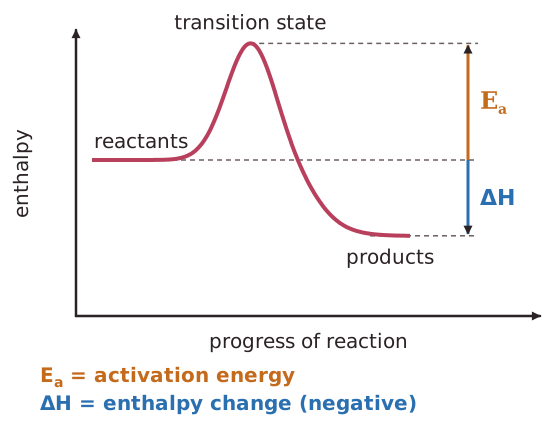
Exothermic Reactions
Read the text
Read the text and highlight anything you think is important. When you go on, the text is hidden and you answer from memory.
Specification: AQA Chemistry (7404), AS-level, 3.1.5.1 Collision theory. Topic: Kinetics.
Key terms in this lesson
- Enthalpy
- A measure of the heat energy stored in a chemical system.
- Enthalpy change
- The heat energy transferred between the system and its surroundings during a process carried out at constant pressure.
- Exothermic
- Describes a reaction in which energy is transferred from the system to the surroundings, so the enthalpy change is negative.
- Activation energy
- The minimum energy required for a reaction to take place.
More in Kinetics
- Collision Theory
- Factors Affecting Rate of Reaction
- Activation Energy
- Endothermic Reactions
- Maxwell-Boltzmann Distribution
- Maxwell-Boltzmann Distribution and Activation Energy
- The Effect of Temperature on Reaction Rate
- Catalysts
All 14 lessons in Kinetics · All AQA AS-level Chemistry topics