 BRAINCAKE
Catalysts
Catalysts are substances that speed up chemical reaction without themselves being chemically changed.
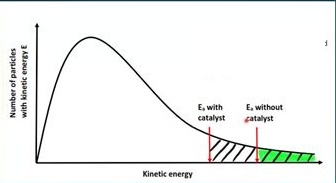
A catalyst provides an alternative reaction pathway with lower activation energy.
Catalysts do not affect the enthalpy change of reactions. At any given temperature, more molecules will have greater than or equal to the activation energy as the activation energy is lower.
Sign in free to see the rest of this lesson, the R.E.C.I.P.E. recall steps and the quiz
BrainCake is free. Make an account in seconds and pick up where this page stops.
Key terms in this lesson
- Enthalpy
- A measure of the heat energy stored in a chemical system.
- Enthalpy change
- The heat energy transferred between the system and its surroundings during a process carried out at constant pressure.
- Activation energy
- The minimum energy required for a reaction to take place.
- Maxwell-boltzmann distribution
- A graph showing the distribution of energies among the molecules of a gas at a given temperature.
- Transition state
- The highest-energy, short-lived arrangement of atoms during a reaction, in which bonds are part broken and part formed.
More in Kinetics
- Endothermic Reactions
- Maxwell-Boltzmann Distribution
- Maxwell-Boltzmann Distribution and Activation Energy
- The Effect of Temperature on Reaction Rate
- Catalytic Converters
- Exam Style Question - 1
- Exam Style Question - 2
- Exam Style Question - 3
All 14 lessons in Kinetics · All AQA AS-level Chemistry topics