Cars have catalytic converters fitted to their exhaust pipes. The catalytic converters are made from a honeycomb of ceramic material coated with the metallic catalysts platinum, palladium or rhodium. The honeycomb provides a large surface area for the reactions:carbon monoxide + nitrogen oxides → carbon dioxide + nitrogenhydrocarbons + nitrogen oxides → nitrogen + carbon dioxide + waterThe reactants are adsorbed onto the surface of the catalyst.Bonds within the reactants break.New bonds form between the reactants.The products desorb from the surface of the catalyst.
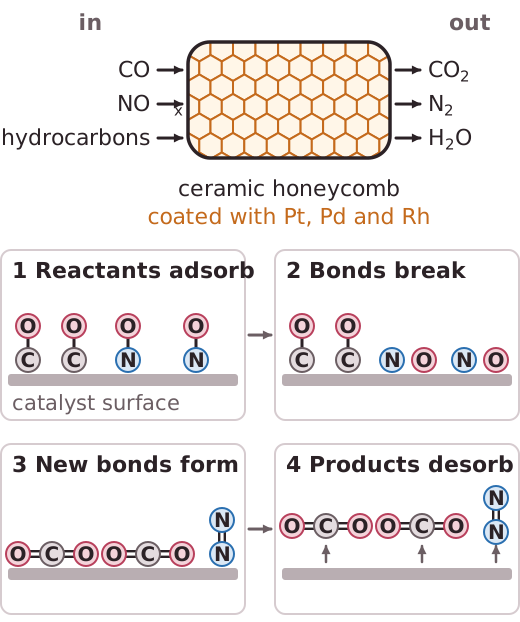
Catalytic Converters
Read the text
Read the text and highlight anything you think is important. When you go on, the text is hidden and you answer from memory.
Specification: AQA Chemistry (7404), AS-level, 3.1.5.5 Catalysts. Topic: Kinetics.
Key terms in this lesson
- Catalyst
- A substance that increases the rate of a chemical reaction without being used up, by providing an alternative reaction pathway with a lower activation energy.
More in Kinetics
- Maxwell-Boltzmann Distribution
- Maxwell-Boltzmann Distribution and Activation Energy
- The Effect of Temperature on Reaction Rate
- Catalysts
- Exam Style Question - 1
- Exam Style Question - 2
- Exam Style Question - 3
- Exam Style Question - 4
All 14 lessons in Kinetics · All AQA AS-level Chemistry topics