Skip to content

Trends in First Ionisation Energy Across a Period

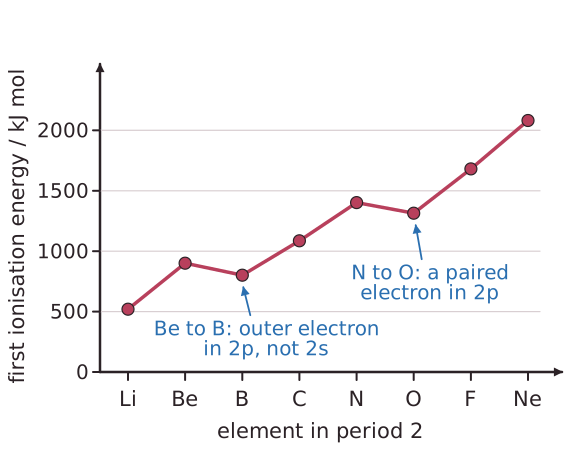
First Ionisation energies increase across a period. This is because the nuclear charge is increasing as there are more protons, but the amount of shielding is the same or similar so the atomic radius decreases across a period.Shielding refers to the repulsion of the electron to be removed by the electrons in the inner shells.From group 2 to 3 however, the ionisation energy decreases. This is because elements in group 3 have their outer electron in the p orbital, which is of slightly higher energy than the s orbital outer electrons of group 2 elements. The p orbital electron in group 3 needs less energy to remove it.The first ionisation energy decreases from group 5 to 6. This is because the electrons in group 6 are paired and the repulsion makes its easier to remove.
 1s   2s  2px 2py 2pz
nitrogen  ↿⇂↿⇂↿↿ ↿ 

 1s   2s  2px 2py 2pz
oxygen   ↿⇂↿⇂↿⇂↿ ↿ 

Read the text

Read the text and highlight anything you think is important. When you go on, the text is hidden and you answer from memory.

Specification: AQA Chemistry (7404), AS-level, 3.1.1.3 Electron configuration. Topic: Atomic Structure.

Key terms in this lesson

Atomic orbital
A region in space around the nucleus where there is a 95% probability of finding an electron of a given energy.
First ionisation energy
The enthalpy change when each atom in one mole of gaseous atoms loses one electron to form one mole of gaseous 1+ ions.
Atomic radius
A measure of the size of an atom, found by measuring the distance between two adjacent nuclei and dividing by two.
Group
A vertical column of the periodic table, containing elements with the same number of outer-shell electrons.
Period
A horizontal row of the periodic table, containing elements with the same number of electron shells.

More in Atomic Structure

All 22 lessons in Atomic Structure · All AQA AS-level Chemistry topics