The ozone layer is a region of the stratosphere containing ozone, O3. It absorbs much of the Sun's harmful ultraviolet radiation, which can cause skin cancer and cataracts.Ozone is formed and broken down naturally: O2 → 2O and O2 + O → O3. This balance has been upset by chlorofluorocarbons (CFCs), which were used in refrigerators and aerosols.In the stratosphere, UV light breaks the C-Cl bond in CFCs to form chlorine radicals, for example CF2Cl2 → •CF2Cl + Cl•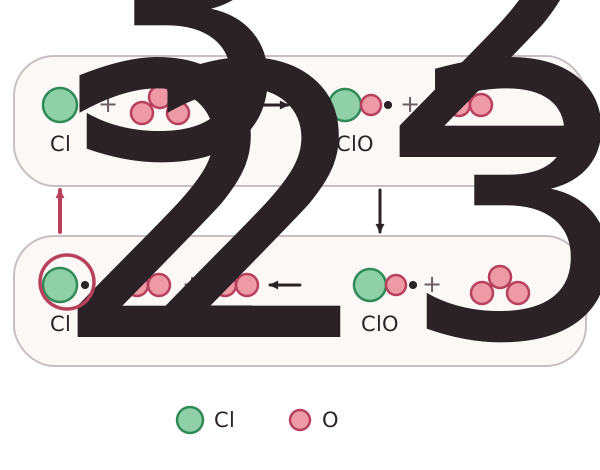 The chlorine radicals then catalyse the breakdown of ozone: Cl• + O3 → ClO• + O2, then ClO• + O3 → 2O2 + Cl•. The overall reaction is 2O3 → 3O2. Because the Cl• is regenerated, one radical can destroy thousands of ozone molecules.Nitrogen monoxide radicals from aircraft and thunderstorms also break down ozone in a similar way. CFCs have been banned under the Montreal Protocol and replaced by alternatives such as HFCs, which do not contain chlorine.