Catalytic converters are fitted to car exhausts to remove carbon monoxide, nitrogen oxides and unburnt hydrocarbons.They contain a ceramic honeycomb coated with a thin layer of platinum, palladium and rhodium. The honeycomb gives a large surface area, so only a small amount of these expensive metals is needed.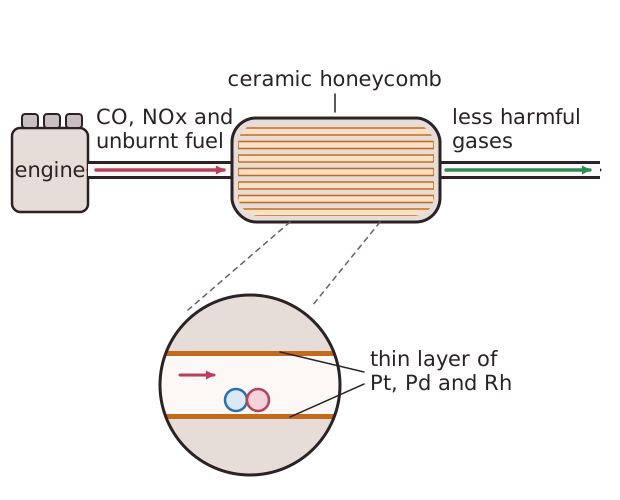 The pollutants react on the surface of the catalyst to form less harmful gases. For example: 2CO + 2NO → 2CO2 + N2Unburnt hydrocarbons react with nitrogen monoxide: C8H18 + 25NO → 8CO2 + 12½N2 + 9H2OCatalytic converters only work well once they are hot, so they are less effective on short journeys. They also still produce carbon dioxide, a greenhouse gas.