Alcohols are classified by the number of carbon atoms bonded to the carbon atom that carries the -OH group.Primary (1°): the C-OH carbon is bonded to one other carbon atom (and two hydrogens). Examples: ethanol, CH3CH2OH, and propan-1-ol, CH3CH2CH2OH. Methanol, CH3OH, has no other carbons but is also treated as primary.Secondary (2°): the C-OH carbon is bonded to two other carbon atoms (and one hydrogen). Example: propan-2-ol, CH3CH(OH)CH3.Tertiary (3°): the C-OH carbon is bonded to three other carbon atoms (and no hydrogens). Example: 2-methylpropan-2-ol, (CH3)3COH.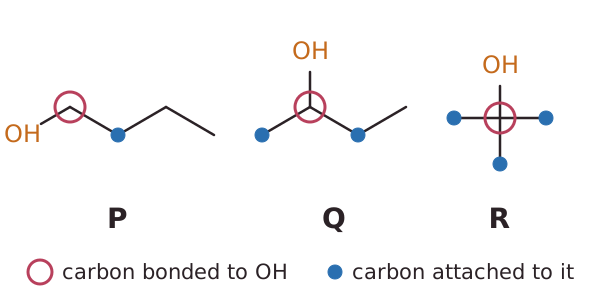 A quick check is to count the hydrogens on the C-OH carbon: primary alcohols contain -CH2OH, secondary alcohols contain -CH(OH)- and tertiary alcohols have none.Worked example: classify the four alcohols with formula C4H9OH.
Butan-1-ol, CH3CH2CH2CH2OH: primary.
2-methylpropan-1-ol, (CH3)2CHCH2OH: primary (the C-OH carbon is bonded to only one carbon, even though the chain is branched).
Butan-2-ol, CH3CH(OH)CH2CH3: secondary.
2-methylpropan-2-ol, (CH3)3COH: tertiary.The classification matters because it decides how an alcohol reacts. With acidified potassium dichromate(VI), primary alcohols are oxidised to aldehydes and carboxylic acids, secondary alcohols to ketones, and tertiary alcohols are not easily oxidised.
A quick check is to count the hydrogens on the C-OH carbon: primary alcohols contain -CH2OH, secondary alcohols contain -CH(OH)- and tertiary alcohols have none.Worked example: classify the four alcohols with formula C4H9OH.Butan-1-ol, CH3CH2CH2CH2OH: primary.
2-methylpropan-1-ol, (CH3)2CHCH2OH: primary (the C-OH carbon is bonded to only one carbon, even though the chain is branched).
Butan-2-ol, CH3CH(OH)CH2CH3: secondary.
2-methylpropan-2-ol, (CH3)3COH: tertiary.The classification matters because it decides how an alcohol reacts. With acidified potassium dichromate(VI), primary alcohols are oxidised to aldehydes and carboxylic acids, secondary alcohols to ketones, and tertiary alcohols are not easily oxidised.