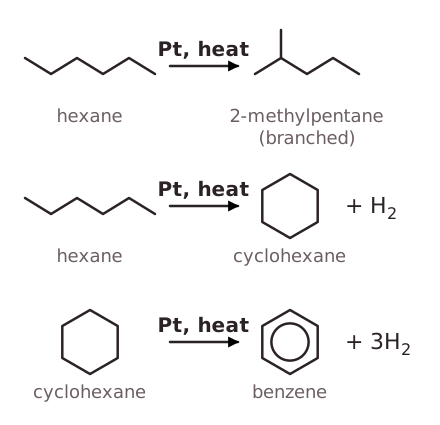
Reforming converts straight-chain alkanes into branched alkanes and cyclic hydrocarbons, including arenes. It is usually done by heating the alkanes with a platinum catalyst.Straight-chain alkanes burn less efficiently in car engines and can ignite too early, causing knocking. Branched and cyclic hydrocarbons burn more smoothly, so reforming improves the quality of petrol.Hydrogen is often produced as a by-product. For example, hexane can be reformed into cyclohexane and hydrogen, and cyclohexane into benzene and three molecules of hydrogen.The products are isomers or ring compounds made from the same number of carbon atoms, so reforming changes the shape of molecules rather than their size.