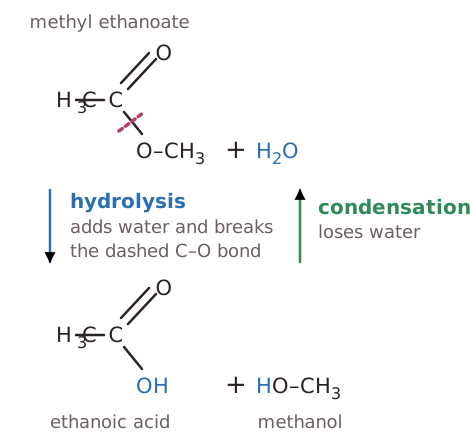
Hydrolysis is the breaking of a covalent bond by reaction with water. It is the reverse of a condensation reaction.Esters can be hydrolysed by heating with dilute acid, which is reversible and gives a carboxylic acid and an alcohol. Heating with aqueous sodium hydroxide goes to completion and gives a carboxylate salt and an alcohol.Halogenoalkanes are hydrolysed by water or hydroxide ions to form alcohols. The rate can be compared using aqueous silver nitrate, because the halide ions released form precipitates.Condensation polymers such as polyesters and polyamides can be hydrolysed back to their monomers, which is why they can be biodegradable.