Nuclear magnetic resonance (NMR) spectroscopy is the most powerful technique for finding the structure of an organic molecule. It shows the different environments of particular atoms in the molecule.NMR works with nuclei that have a property called nuclear spin. At A level the two you need are 1H (protons) and 13C. The common isotope 12C has no spin, so it gives no NMR signal.A spinning nucleus behaves like a tiny magnet. When the sample is placed in a strong external magnetic field, the nuclei line up either with the field (lower energy) or against it (higher energy). The sample is then exposed to radio frequency radiation. Nuclei absorb energy of exactly the right frequency and flip to the higher energy state: this is resonance.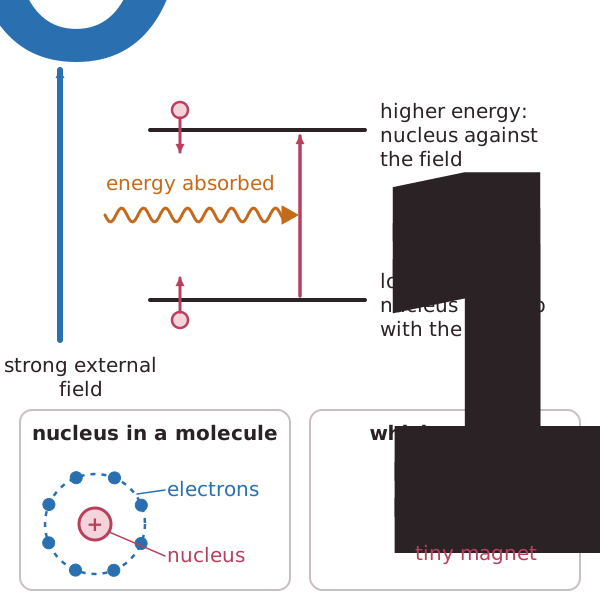 The exact frequency absorbed depends on the chemical environment of the nucleus: the other atoms and electrons around it. Electrons shield the nucleus from the external field, so nuclei in different environments absorb at slightly different frequencies and give separate peaks.Worked example: in ethanol, CH3CH2OH, the two carbon atoms are in different environments (one is bonded to oxygen), so the 13C NMR spectrum has 2 peaks.The two types of spectrum give complementary information: 13C NMR shows the carbon skeleton, and 1H NMR shows how the hydrogen atoms are arranged. NMR uses low-energy radio waves, and the same principle is used in hospital MRI scanners.