In a high-resolution 1H NMR spectrum, many peaks are not single lines but are split into a cluster of smaller peaks. This is called spin-spin splitting (or spin-spin coupling).Splitting is caused by protons on the adjacent carbon atom. Each neighbouring proton has its own small magnetic field, which can line up with or against the applied field. This slightly changes the field felt by the proton being observed, so its signal is split into sub-peaks.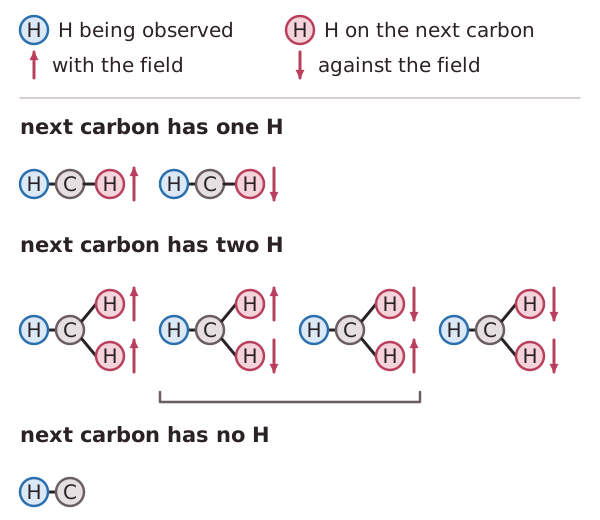 Important points:
• Only non-equivalent protons on adjacent carbons cause splitting. Protons in the same chemical environment do not split each other.
• Splitting is mutual: if protons A split protons B, then protons B also split protons A.The split peaks have names and characteristic relative heights:
• singlet: 1 peak
• doublet: 2 peaks, 1 : 1
• triplet: 3 peaks, 1 : 2 : 1
• quartet: 4 peaks, 1 : 3 : 3 : 1
• multiplet: a more complex pattern of peaksExample: chloroethane, CH3CH2Cl, has two proton environments. The CH3 peak is split by the two CH2 protons into a triplet. The CH2 peak is split by the three CH3 protons into a quartet. The CH2 quartet is at the higher chemical shift because it is next to the electronegative chlorine atom.Splitting patterns tell you about neighbouring groups, so they show how the parts of a molecule are joined together.
Important points:• Only non-equivalent protons on adjacent carbons cause splitting. Protons in the same chemical environment do not split each other.
• Splitting is mutual: if protons A split protons B, then protons B also split protons A.The split peaks have names and characteristic relative heights:
• singlet: 1 peak
• doublet: 2 peaks, 1 : 1
• triplet: 3 peaks, 1 : 2 : 1
• quartet: 4 peaks, 1 : 3 : 3 : 1
• multiplet: a more complex pattern of peaksExample: chloroethane, CH3CH2Cl, has two proton environments. The CH3 peak is split by the two CH2 protons into a triplet. The CH2 peak is split by the three CH3 protons into a quartet. The CH2 quartet is at the higher chemical shift because it is next to the electronegative chlorine atom.Splitting patterns tell you about neighbouring groups, so they show how the parts of a molecule are joined together.