13C NMR spectroscopy gives information about the carbon skeleton of a molecule. Only about 1% of carbon atoms are 13C, but modern spectrometers are sensitive enough to detect them.Each peak on a 13C spectrum represents one carbon environment. So the number of peaks equals the number of different carbon environments in the molecule.Carbon atoms are in the same environment (equivalent) if they are bonded to exactly the same atoms and groups, which is often shown by a line of symmetry in the molecule. Equivalent carbons give a single peak.The chemical shift, δ, of each peak shows the type of carbon environment: a carbon bonded to an electronegative atom, or part of a C=O group, has a larger shift.Unlike 1H spectra, a 13C spectrum at A level shows single lines with no splitting, and the heights of the peaks are not used to count carbons.Worked example: how many peaks do propan-1-ol and propan-2-ol give?
• Propan-1-ol, CH3CH2CH2OH: all three carbons are different, so 3 peaks.
• Propan-2-ol, CH3CH(OH)CH3: the two CH3 groups are equivalent by symmetry, so 2 peaks.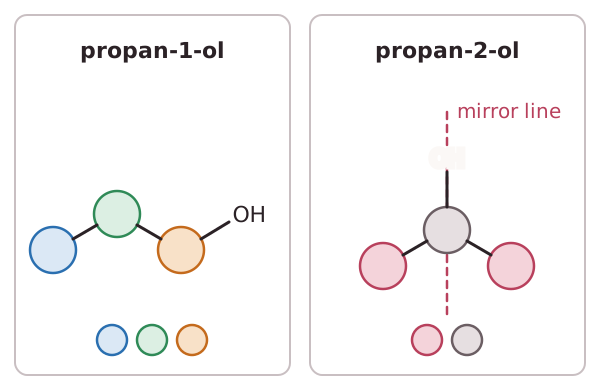 So 13C NMR can tell these structural isomers apart. For a benzene ring, count environments carefully: benzene itself gives 1 peak, while methylbenzene, C6H5CH3, gives 5 (four ring environments plus the CH3).
• Propan-1-ol, CH3CH2CH2OH: all three carbons are different, so 3 peaks.
• Propan-2-ol, CH3CH(OH)CH3: the two CH3 groups are equivalent by symmetry, so 2 peaks.
So 13C NMR can tell these structural isomers apart. For a benzene ring, count environments carefully: benzene itself gives 1 peak, while methylbenzene, C6H5CH3, gives 5 (four ring environments plus the CH3).