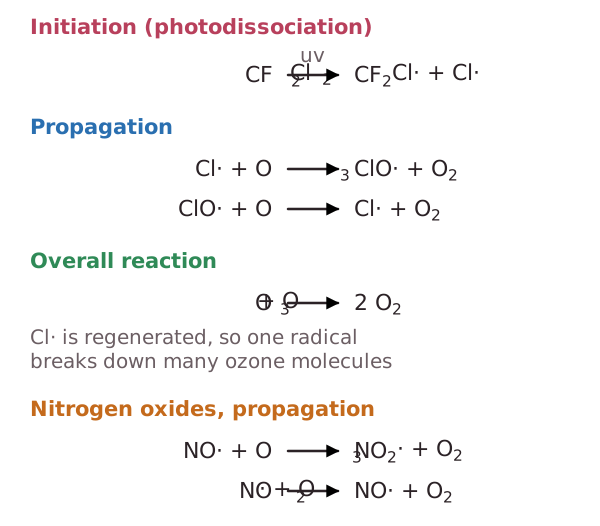
The ozone layer is found 10 - 40km above the earth's surface in the outer stratosphere. It blocks harmful uv-B radiation from the Sun. In the stratosphere ozone is continually being formed and broken down by uv light. In the steady state, the rate of ozone formation is equal to the rate of ozone breakdown. CFCs and HCFCs were used as refrigerants and aerosol propellants. CFCs are very stable and relatively inert due the strength of the carbon halogen bonds.It may take CFCs many years to reach the stratosphere where u.v. radiation provides enough energy to break the C-X bond by homolytic fission which forms highly reactive chlorine radicals. These react with ozone molecules breaking them down into molecular oxygen. This is a chain reaction. One chlorine radical can break down 100 000 ozone molecules.