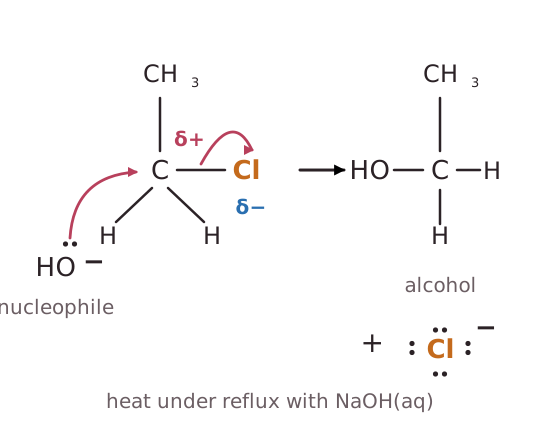
The addition of water can be used to break a bond and split a molecule into 2 products. This is called hydrolysis. The mechanism of hydrolysis is nucleophilic substitution. The halogen atom is replaced by an OH group converting the halogenoalkane to an alcohol.The reaction is slow at room temperature so the halogenoalkane must be heated under reflux with aqueous sodium hydroxide in ethanol.CH3CH2CH2CH2Br + NaOH → CH3CH2CH2CH2OH + NaBr The rate of hydrolysis depends on the strength of the C-X bond. Iodoalkanes react faster than bromoalkanes. Bromoalkanes react faster than chloroalkanes. Fluoroalkanes are unreactive.