Oxidation is the loss of electrons by an atom, ion or molecule. e.g.H2(g) → 2H+(aq) + 2e-Oxidation is also the increase in oxidation number.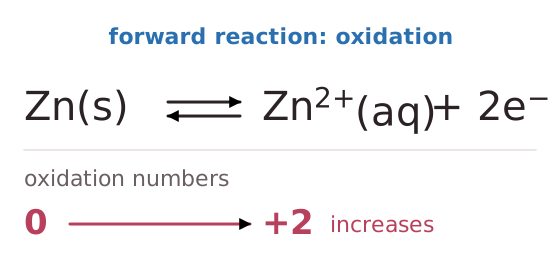 Reduction is the gain of electrons by an atom, ion or molecule.Zn2+(aq) + 2e- ⇌ Zn(s)or the decrease in oxidation number. In a redox reaction, both oxidation and reduction take place. The oxidation number is a measure of the number of electrons that an atom uses to bond with an atom of another element.
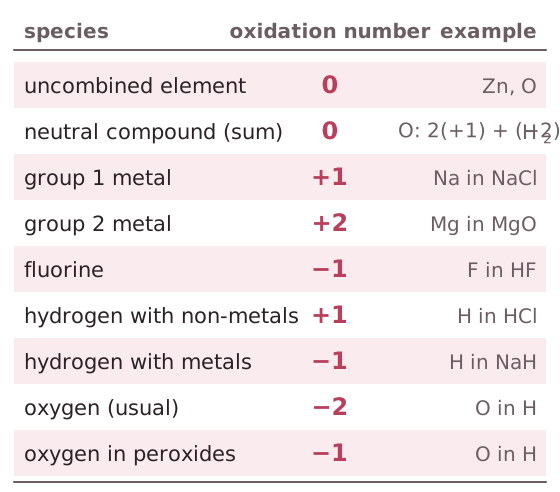
Reduction is the gain of electrons by an atom, ion or molecule.Zn2+(aq) + 2e- ⇌ Zn(s)or the decrease in oxidation number. In a redox reaction, both oxidation and reduction take place. The oxidation number is a measure of the number of electrons that an atom uses to bond with an atom of another element.