 BRAINCAKE
Electrochemical Cells
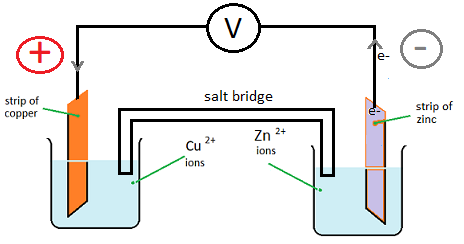
An electrochemical cell can be made by connecting two half cells together. Each half cell has a different potential so one half cell has a greater tendency to accept electrons than the other. As a result, one half cell releases electrons and the other half gains electrons. The difference in electrode potentials between the two cells, the potential difference, is measured with a voltmeter. The circuit is completed with a salt bridge which is a piece of filter paper soaked in aqueous potassium or ammonium nitrate or potassium chloride. The salt bridge is soaked in an ionic compound that does not react with either of the solutions in the half cells.
Sign in free to see the rest of this lesson, the R.E.C.I.P.E. recall steps and the quiz
BrainCake is free. Make an account in seconds and pick up where this page stops.
Key terms in this lesson
- half cell
- A system consisting of an element in two different oxidation states, in which an equilibrium is set up between the two forms.
More in Electrochemistry
- Oxidation and Reduction
- Ionic Equations
- Electrochemical Half Cells
- The Standard Hydrogen Half Cell
- Standard Electrode Potential Eθ and the Electrochemical Series
- Calomel Electrode
- Standard Cell Potentials Eθcell Values and Electrochemical Cells
- Non-Standard Conditions
All 14 lessons in Electrochemistry · All OCR A-level Chemistry topics