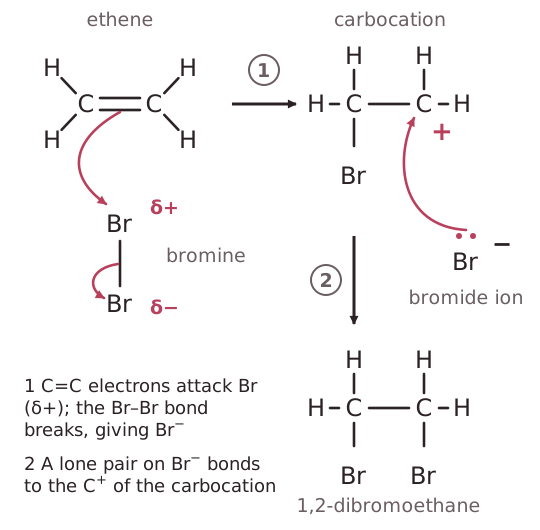
Alkenes react readily with halogens at room temperature and in the dark. The reaction of alkenes with bromine is used as a test for a C=C double bond. Alkenes will turn bromine water from orange to colourless. The mechanism of the reaction is electrophilic addition.When the non-polar bromine molecule approaches the alkene in a particular orientation, the repulsion of the bonding pair of electrons by the electron dense region of the C=C double bond causes heterolytic fission. The positive Br+ ion then forms a bond with the π electrons and a carbocation and negative bromide ion remains. The negative bromide ion forms a bond with the positive carbon ion forming a dibromoalkane.Alkenes react with chlorine and iodine in a similar way.