The n+1 rule: a hydrogen environment with n hydrogen atoms on the adjacent carbon atom(s) is split into n + 1 lines.• n = 0: singlet
• n = 1: doublet, heights 1:1
• n = 2: triplet, heights 1:2:1
• n = 3: quartet, heights 1:3:3:1
• n = 6: septet (7 lines)
The relative heights of the lines follow Pascal's triangle.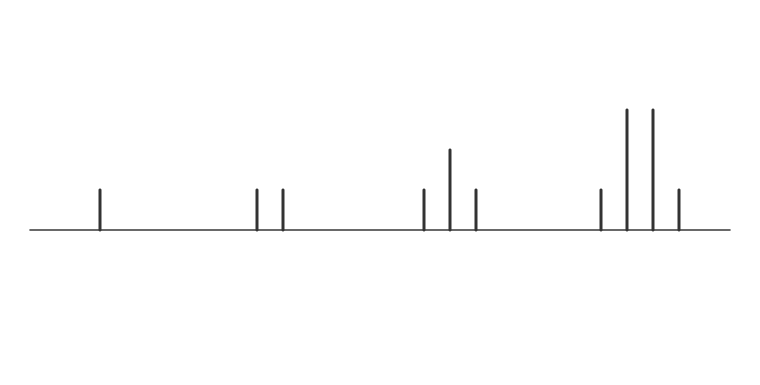
• CH3: the neighbouring carbon has 2 H, so n = 2 and the peak is a triplet (3H, about δ 1.5)
• CH2: the neighbouring carbon has 3 H, so n = 3 and the peak is a quartet (2H, about δ 3.6)
A quartet (2H) together with a triplet (3H) is the sign of an ethyl group, CH3CH2-.An isopropyl group, (CH3)2CH-, gives a doublet (6H) and a septet (1H), because each CH3 has 1 neighbouring H and the CH has 6.A singlet means the group has no H on the adjacent atoms, for example a CH3 bonded to C=O in CH3CO-.
• n = 1: doublet, heights 1:1
• n = 2: triplet, heights 1:2:1
• n = 3: quartet, heights 1:3:3:1
• n = 6: septet (7 lines)
The relative heights of the lines follow Pascal's triangle.
• CH3: the neighbouring carbon has 2 H, so n = 2 and the peak is a triplet (3H, about δ 1.5)
• CH2: the neighbouring carbon has 3 H, so n = 3 and the peak is a quartet (2H, about δ 3.6)
A quartet (2H) together with a triplet (3H) is the sign of an ethyl group, CH3CH2-.An isopropyl group, (CH3)2CH-, gives a doublet (6H) and a septet (1H), because each CH3 has 1 neighbouring H and the CH has 6.A singlet means the group has no H on the adjacent atoms, for example a CH3 bonded to C=O in CH3CO-.