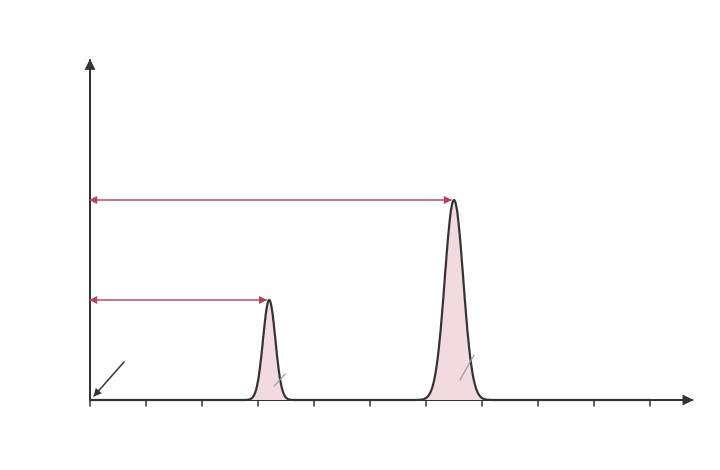
In gas chromatography (GC) and high performance liquid chromatography (HPLC), the components of a mixture are carried through a column by the mobile phase and separated by how strongly they interact with the stationary phase.The retention time is the time taken for a component to pass through the column: from the moment the sample is injected to the moment that component reaches the detector (measured at the peak maximum). A component that is more soluble in, or more strongly adsorbed onto, the stationary phase has a longer retention time.Retention time depends on the conditions, including the type and length of the column, the stationary phase, the column temperature and the flow rate (and pressure) of the mobile phase. To identify an unknown, its retention time is compared with that of a known pure sample run under identical conditions. A match suggests, but does not prove, the same compound, because two different compounds can have the same retention time. This is why GC and HPLC are often linked to a mass spectrometer, which identifies each component as it leaves the column.