In a closed system a reversible reaction eventually reaches a dynamic equilibrium where the rate of forward reaction = the rate of the reverse reaction and the concentrations of the reactants and products remain the same. The Equilibrium Law - (also known as the law of mass action) for the reversible reaction:aA + bB ⇌ cC + dD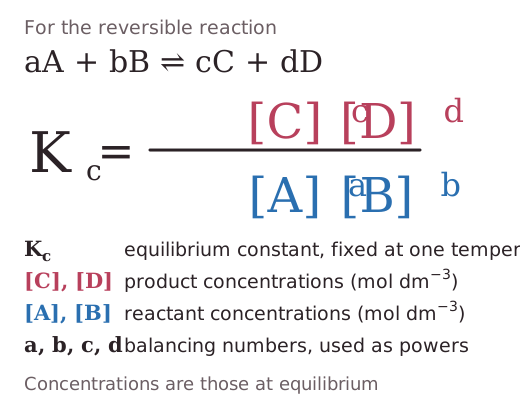 Kc is the equilibrium constant at a given temperature. The right hand side is called the equilibrium quotient, Q. When a system has reached dynamic equilibrium, Q = Kc. [A] means the concentration of A. If Kc is greater than 1010 reactions are considered as going to completion. If Kc is less than 10-10 the reaction is regarded as not taking place at all.