Catalysts have no effect on the value of Kc. They affect both the rates of the forward and reverse reactions by the same amount. Catalysts affect the rate at which equilibrium is reached.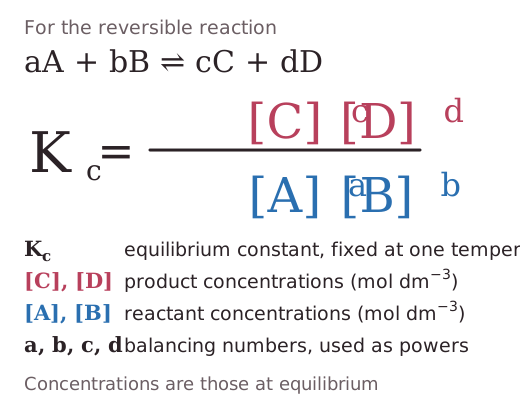 A catalyst provides an alternative reaction route with a lower activation energy. The forward and reverse reactions both pass through this same route, so the activation energy of each is lowered by the same amount and both rates increase by the same factor.Kc compares the equilibrium concentrations of the products with those of the reactants. Because the forward and reverse rates change equally, the equilibrium concentrations are the same with or without a catalyst, so neither the value of Kc nor the position of equilibrium changes. Only a change in temperature changes the value of Kc.What a catalyst does change is how quickly equilibrium is reached. This matters in industry. In the Haber process,
N2(g) + 3H2(g) ⇌ 2NH3(g) an iron catalyst gives a reasonable rate at a moderate temperature (about 450 °C), so the equilibrium yield does not have to be sacrificed to a very high temperature. The catalyst does not increase the equilibrium yield of ammonia. It only produces the equilibrium mixture faster, which saves time and energy costs.
A catalyst provides an alternative reaction route with a lower activation energy. The forward and reverse reactions both pass through this same route, so the activation energy of each is lowered by the same amount and both rates increase by the same factor.Kc compares the equilibrium concentrations of the products with those of the reactants. Because the forward and reverse rates change equally, the equilibrium concentrations are the same with or without a catalyst, so neither the value of Kc nor the position of equilibrium changes. Only a change in temperature changes the value of Kc.What a catalyst does change is how quickly equilibrium is reached. This matters in industry. In the Haber process,