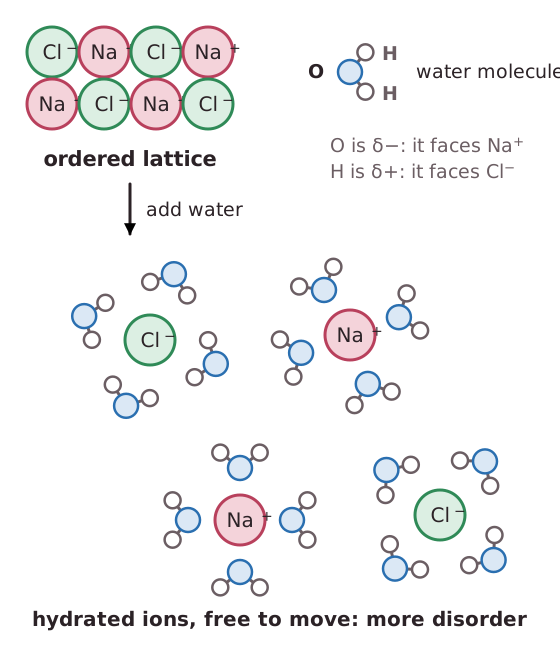
The second law of thermodynamic states that spontaneous changes result in an increase in disorder or entropy. This determines the direction of any physical, chemical or biological change. However, an increase in entropy means an increase in entropy of both the system and the surroundings.ΔStotal = ΔSsystem + ΔSsurroundingsThe second law of thermodynamics determines, for example, whether a reaction will occur at a given temperature, whether a redox reaction will take place, the position of equilibrium in a reversible reaction. The entropy change of the surroundingsΔSsurroundings = - ΔH / Tso the entropy change of the surroundings is inversely proportional to the absolute temperature.