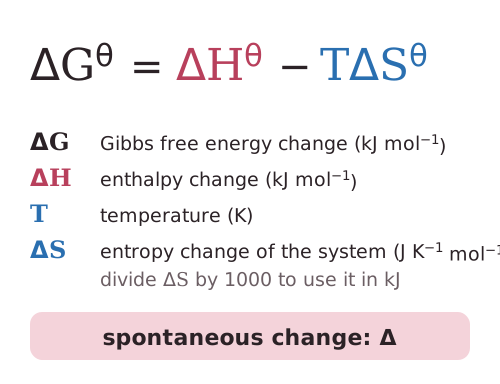
Changes are thermodynamically feasible if the total entropy change is positive, so for an endothermic reaction, if an increase in entropy is more significant than the endothermic nature of the reaction will be spontaneous. For example when pure ethanoic acid is added to solid ammonium carbonate a violent reaction takes place.2CH3COOH(l) + (NH4)2CO3(s) → 2CH3COONH4(s) + H2O (l) + CO2(g)The reaction is endothermic, but there is an increase in the total entropy, ΔStotal is positive so the reaction is thermodynamically spontaneous.The free energy measured at constant pressure is called the Gibbs Free EnergyΔGθ = ΔHθ - TΔSθwhere T is in Kelvin and ΔSθ is the entropy change of the system. ΔG is a measure of the chemical potential of a system. For a reaction to be spontaneous ΔG must be negative.
Spontaneous Reactions and Gibbs Free Energy
Read the text
Read the text and highlight anything you think is important. When you go on, the text is hidden and you answer from memory.
Specification: Edexcel Chemistry (9CH0), A-level, Topic 13B: Entropy. Topic: Entropy.
Key terms in this lesson
- hess's law
- The enthalpy change of a reaction is the same regardless of the route taken, provided the initial and final conditions are identical.
- lattice enthalpy
- The enthalpy change when one mole of an ionic lattice is formed from its constituent ions in the gaseous state, under standard conditions.
More in Entropy
- Entropy
- The Second Law of Thermodynamics
- The Entropy Change of a System
- The Effect of Temperature on Entropy
- The Entropy Change of the Surroundings
All 6 lessons in Entropy · All Edexcel A-level Chemistry topics